

Every year millions of candidates sit online proctored certification exams from home. Some pass on the first attempt. Many do not. The question candidates ask most often before registering is the one nobody answers honestly: which of these exams is actually the hardest?
The answer depends on what kind of hard you mean.
Hard because the content is deep. Hard because the format punishes the unprepared. Hard because the time pressure is unforgiving. Hard because one failed attempt can cost you a job offer, a promotion or an application deadline.
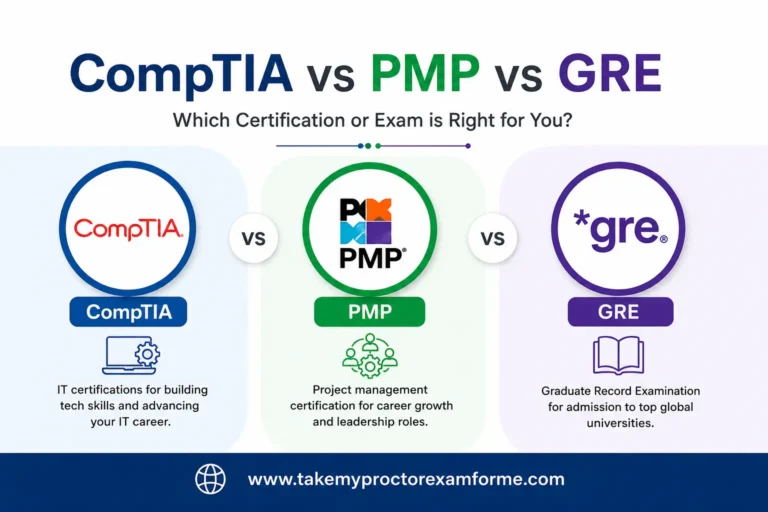
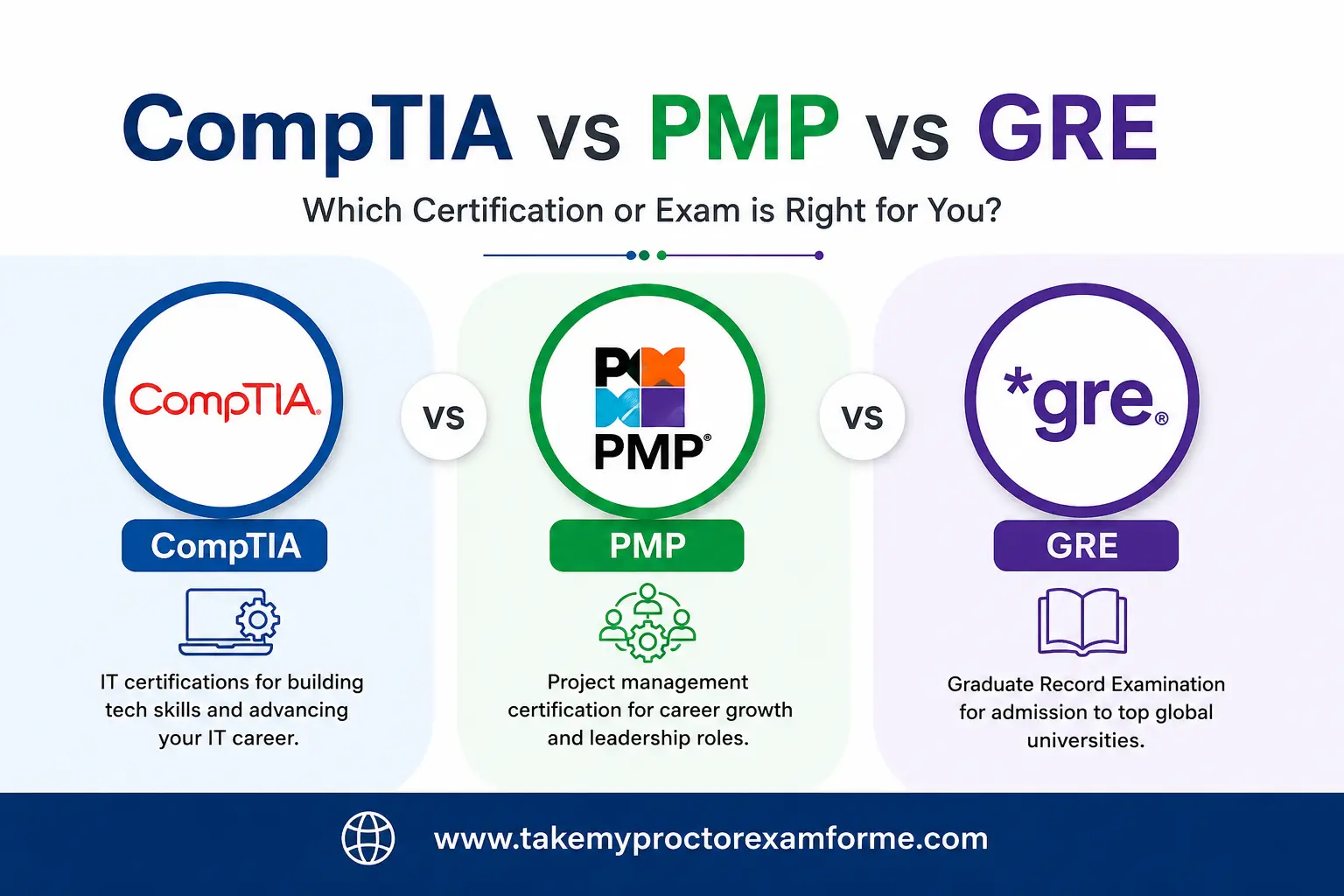
This comparison covers three of the most widely sat online proctored certifications in 2026: CompTIA certifications, the Project Management Professional credential and the GRE General Test. Each one is hard in a different way. Understanding which kind of hard you are dealing with is the difference between preparing correctly and walking into the exam blind.
CompTIA Certifications: Hard Because the Format Fights You
CompTIA runs some of the most recognised IT certifications in the world. Security+, Network+, A+, CySA+ and others are delivered through Pearson VUE OnVUE at home with a live remote proctor watching throughout.
The pass rates tell part of the story. CompTIA does not publish official first-attempt pass rates but industry estimates from training providers put Security+ SY0-701 first-attempt pass rates at around 60 to 65 percent. For candidates who have studied extensively, that number is surprisingly low.
The reason is the performance based question format.
According to CompTIA’s official exam objectives documentation, Security+ SY0-701 includes performance based questions that appear at the start of the exam. These are simulation questions that require candidates to complete a task in a virtual environment rather than selecting a multiple choice answer. Each one takes three to five minutes. A candidate who attempts them in order spends 20 minutes before reaching the first multiple choice question, leaving 70 minutes for the remaining 85 questions.
Candidates who know this go in with a strategy: flag PBQs, complete all multiple choice first, return to PBQs with remaining time. Candidates who do not know this run out of clock on a paper they could have passed.
CompTIA also uses scaled scoring. The passing score for Security+ is 750 on a 100 to 900 scale. This is not 83 percent of questions answered correctly. Questions carry different weights based on difficulty and domain. Security Operations at 28 percent of the exam carries more scaled score weight than General Security Concepts at 12 percent. A candidate who is strong on concepts but weak on applied security operations can score 75 percent of questions correctly and still fail.
Network+ N10-009 adds another layer of difficulty: the exam updated in June 2024 and candidates studying from older materials are preparing for a different domain structure. Troubleshooting is now 24 percent of the exam, the highest weighted domain. A candidate who weighted security heavily in their preparation based on the old N10-008 structure walks into the wrong exam.
For working professionals attempting CompTIA certifications under employer deadlines, the combination of format complexity, scaled scoring and domain weighting makes these exams significantly harder than their reputation suggests. If you are sitting a CompTIA exam online and want to understand what support options exist, our take my proctored exam for me service covers Security+, Network+, A+ and other CompTIA certifications through Pearson VUE OnVUE.
PMP: Hard Because the Thinking Required Is Non-Linear
The Project Management Professional certification is administered by the Project Management Institute and delivered through Pearson VUE OnVUE at home. According to PMI’s official PMP examination content outline, the current exam is split roughly 50 percent predictive project management and 50 percent agile and hybrid approaches.
PMI reports a pass rate of approximately 60 percent for first-time candidates. That figure comes from PMI’s own published data and represents a significant failure rate for what is often described as a straightforward management certification.
The difficulty is not factual recall. It is situational judgment.
PMP questions are scenario based. A question describes a project management situation and asks what a project manager should do next. Four answers are all plausible. The correct answer is the one that best reflects PMI’s methodology, which prioritises communication, stakeholder engagement and proactive risk management in a specific sequence that often differs from what an experienced project manager would actually do in the real world.
This creates a specific failure pattern. Experienced project managers with 10 or 15 years of real delivery experience fail the PMP because they answer from experience rather than from PMI’s framework. They choose the answer that reflects what they would do on an actual project, not the answer PMI considers correct.
The 180 question format running for 230 minutes adds time pressure to judgment pressure. Some questions are pretest items that do not count toward the final score but candidates cannot identify which ones. Every question requires full engagement regardless of whether it counts.
The shift to hybrid agile content in the current exam caught many candidates who prepared primarily on predictive methodology. PMI’s exam now expects candidates to distinguish between when to use a predictive waterfall approach and when to use an agile or hybrid approach, and to apply the right framework to the scenario presented.
For professionals sitting the PMP under employer timelines or contract requirements, our dedicated PMP exam help page covers the current exam format through Pearson VUE OnVUE.
GRE: Hard Because It Tests How You Think Under Adaptive Pressure
The GRE General Test is administered by ETS and delivered through ETS at home proctoring with ProctorU monitoring. According to ETS’s official GRE score data, the average Quantitative Reasoning score for all test takers is around 153 out of 170. The average Verbal Reasoning score is around 151 out of 170.
Graduate programmes that accept GRE scores typically want 160 or above in the section they weight most heavily. Law school wants Verbal above 160. Data science programmes want Quant above 162. The gap between the average score and the competitive score is significant.
The reason is the section adaptive format.
The GRE divides Verbal and Quantitative Reasoning into two sections each. Performance in Section 1 determines the difficulty level of Section 2. A candidate who performs strongly in Quantitative Section 1 gets a harder Section 2. A harder Section 2 has a higher score ceiling. A candidate who treats Section 1 as a warmup and performs moderately caps their score ceiling before Section 2 begins.
This mechanism is counterintuitive. Most candidates assume a harder Section 2 is a bad sign. It is the opposite. A harder Section 2 is the only path to a 165 or above in Quantitative Reasoning. Candidates who do not understand this cannot strategise for it.
The Analytical Writing section adds a third layer of difficulty. AWA is the only GRE section scored by a human rater alongside the e-rater algorithm. It rewards argument structure and counterpoint development in 30 minutes. Professional writers regularly score 3.5 on AWA because they write polished prose rather than structured argument. A 30 minute essay with a clear counterpoint paragraph scores above a polished essay that never addresses the opposition.
The GRE also has the most diverse buyer pressure of the three exams. A law school applicant needs Verbal. A data science programme needs Quant. A PhD programme in education needs AWA. One exam delivers three scores to three different audiences with three different weightings. A candidate applying to multiple programme types simultaneously has to hit multiple section targets in one sitting.
So Which One Is Actually Hardest?
Depends on who you are.
If you are an IT professional who knows the content cold but struggles under timed exam conditions with simulation questions, CompTIA is the hardest. The format works against you even when the knowledge is there.
If you are an experienced project manager who has delivered dozens of successful projects, the PMP is the hardest. Your experience becomes a liability when PMI’s framework says to do something different from what a decade of real delivery taught you.
If you are a strong student with high academic ability but no experience with adaptive testing, the GRE is the hardest. The mechanism that determines your score ceiling is invisible unless you have been told about it, and most prep courses do not explain it clearly enough to change behaviour in the exam.
All three share one characteristic: the most common failure pattern is not a knowledge gap. It is a performance gap under specific exam conditions that practice tests do not fully replicate.
That gap is what our CompTIA exam help service, PMP support and GRE exam help address. Candidates who have studied adequately and keep failing the same exam are not failing because they do not know enough. They are failing because the format, the clock, the adaptive mechanism or the framework thinking required is different from anything their preparation prepared them for.
The exam is the variable. Changing who sits it changes the outcome.